Exhibition: Desperate Remedy/Little Ones (SDSMT)
- Type
- Solo
- Venue
- APEX Gallery
- Address
- 501 E. Saint Joseph St. , Rapid City, SD, USA
- Dates
- Jan 21st, 2026—Mar 13th, 2026
Show Description
In “Desperate Remedy/Little Ones,” artist Chris Combs, 2025 artist-in-residence at the Sanford Underground Research Facility (SURF), asks: What is it like to hunt something invisible, omnipresent, and vanishingly tiny, which leaves almost no trace of its existence? This exhibition of interactive and time-based sculptures, which are made with found objects, metal, wood, and industrial materials, considers the neutrino, a tiny, almost-massless particle found in staggering quantities all around us. Its central installation, “Little Ones,” places visitors into the perspective of the neutrino by allowing them to “collide” with hanging “atoms,” made with used copper gaskets from a detector at SURF and the artist's own custom circuit boards. The Sanford Underground Research Facility is set in the former Homestake gold mine in Lead, S.D., with many experiments occurring at a depth of 4,850ft under the surface. These include the football-field-sized Deep Underground Neutrino Experiment (DUNE), which will receive a beam of particles sent 800 miles through the earth’s crust from a particle accelerator at Fermilab, near Chicago, IL.Included Works
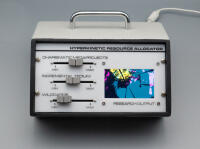
Hyperkinetic Resource Allocator
Art Machines | 07 Oct 2025

Last Place (You Look)
Art Machines | 07 Oct 2025

Little Ones
Art Machines | 07 Oct 2025

November 13, 1970
Art Machines | 07 Oct 2025
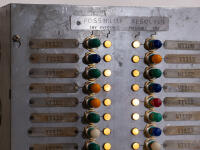
Possibility Resolver
Art Machines | 07 Oct 2025
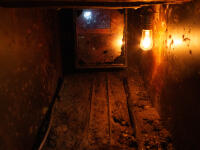
Starstuff
Art Machines | 07 Oct 2025

Subatomic
Art Machines | 07 Oct 2025
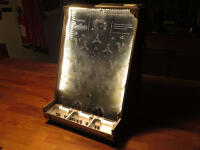
The Astonishing Oscillator
Art Machines | 07 Oct 2025
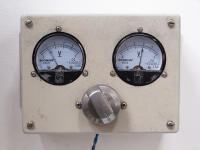
Ungenauigkeit-01
Art Machines | 07 Oct 2025

Whispers of the Early Universe
Art Machines | 07 Oct 2025
Artist's Statement
What is it like to hunt something invisible, omnipresent, and vanishingly tiny, which leaves almost no trace of its existence? I have to imagine it involves a lot of conviction.
A neutrino, literally a “little neutral one,” is a strange, almost massless elementary particle. They are so tiny that they pass through comparatively-huge atoms without stopping or changing directions. They whiz through entire planets—indeed, a neutrino can pass through a light-year of lead. Trillions of neutrinos pass through you every second.
We know little about them, in part because they are so impassive that they are almost impossible to detect. How would we ever know that they exist?
The secret is that every so often, an incredibly unlucky neutrino has a coyote-meets-brick-wall moment and hits the nucleus of an atom. In the right context, there is a brief flash of light as it is annihilated. That’s just enough to spot: Teams of researchers and engineers have gone to great extremes to build cavernous underground neutrino detectors. These pitch-black cavities are filled with powerful sensors, watching for single photons emitted by a neutrino’s final moment.
Neutrinos were theorized long before we worked this out. When physicist Wolfgang Pauli first realized that nuclear beta decay seemed to violate the law of conservation of energy, he wrote to other physicists—addressing his “radioactive ladies and gentlemen”—proposing a new kind of particle to explain away the mis-matched math: a “desperate remedy.”
To paraphrase—’Our math doesn’t work out. Gotta be, uh, an invisible, undetectable thing, probably, which explains everything.’ Pauli sent this sketchy proposal via an intermediary instead of meeting his colleagues in person, likely because of his fear of their response. But he was right in the end; today’s most exciting physics experiments are chasing the neutrino.
Why do we care? Well—Exploding stars create neutrinos; so did the Big Bang. If you had magic neutrino-detecting glasses, looking anywhere in the sky, you’d see neutrinos created less than a second after the Big Bang—still hurtling around after all this time. They might explain one of the biggest mysteries of existence: Why did matter win out over antimatter? In the Big Bang, there should have been an equal amount of each, obliterating each other.
Yet, somehow, matter won out over total annihilation, by a tiny fraction—making it possible for our sun, planet, and bodies to exist. One compelling theory is that neutrinos and their Jekyll-and-Hyde opposite, the antineutrino, may hold the answer: These lonely travelers might be the one exception in the entire model of balanced matter/antimatter—allowing us to exist.
As an artist who focuses on the ways that we shape technologies, and how they shape us back, the hunt for the neutrino is a remarkable lens. If human understanding is a stone pyramid, there was one neutrino-shaped block missing at the bottom. After a massive investment of energy, materials, and time—and some huge leaps of faith—we found it. But when lifted, the block turned into a wave, and then a message, and then a spiraling portal.
—Chris Combs
Follow for New Artwork
Instagram Mastodon Bluesky Facebook